Compas: planning that shows its consequences
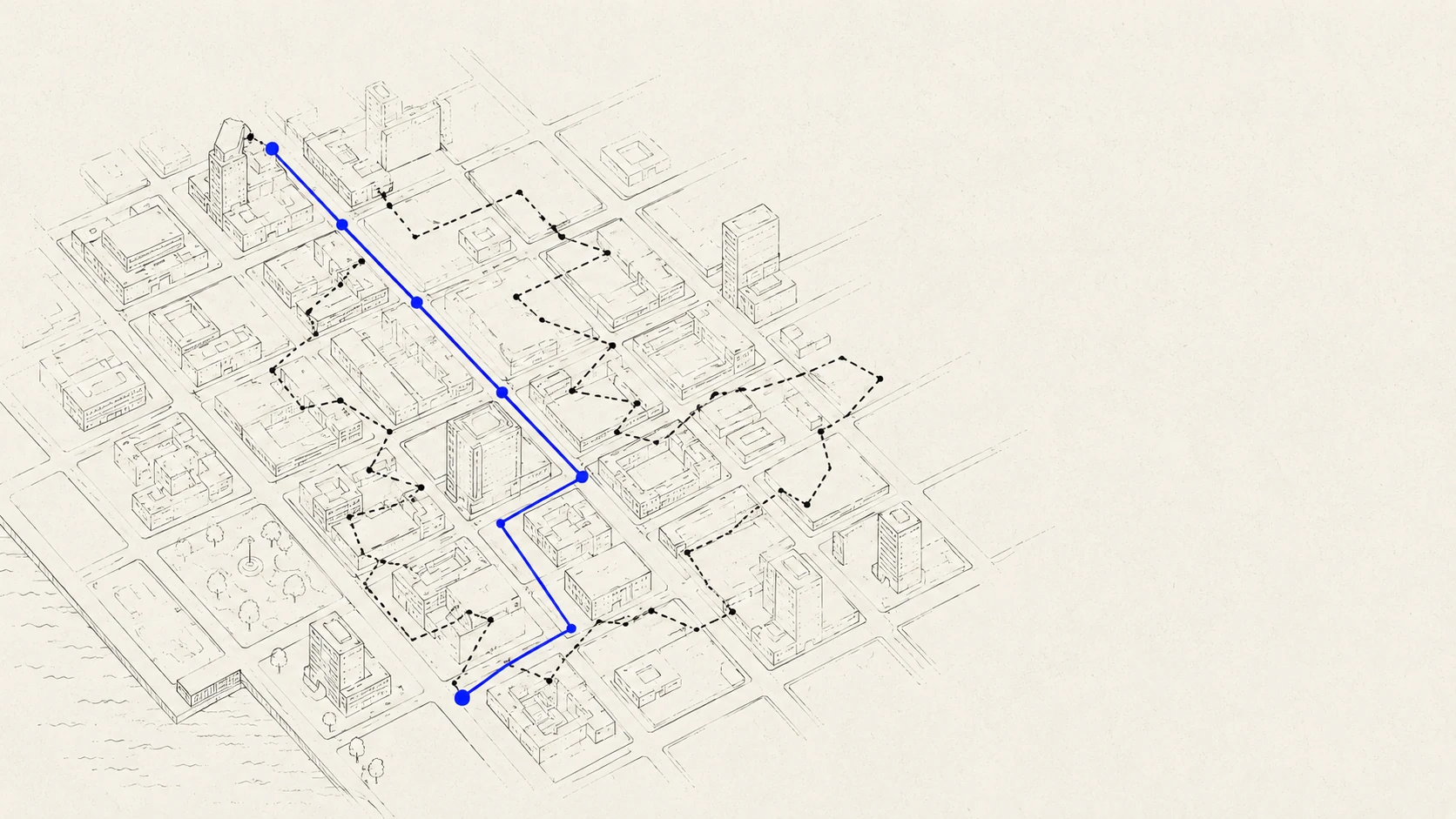
Compas started as hours of my life I couldn’t get back — trip planning, daily schedules, family gatherings across two countries — with a dozen tools open and none of them able to answer the only question that mattered: will this plan actually work?
01The hunch
Planning failure has a shape: you commit to an agenda, then the day reveals what the tools never showed — the 40 minutes lost re-crossing a city, the reservation that conflicts with the tour, the cost that compounded three choices back. The information existed at planning time. Nothing rendered it. Compas is the bet that consequences are renderable — and that seeing them changes what people plan.
02Who it’s for
Four planners share one problem: travelers building ambitious itineraries, schedule-maximizers packing real days, tour operators sequencing groups through a city, and event planners running a hike, a bar crawl, a design-week crawl. Different stakes, same structure — their plan lives simultaneously on a map and on a clock, and every existing tool makes them hold one of the two in their head.
03The interaction bet: two surfaces, one plan
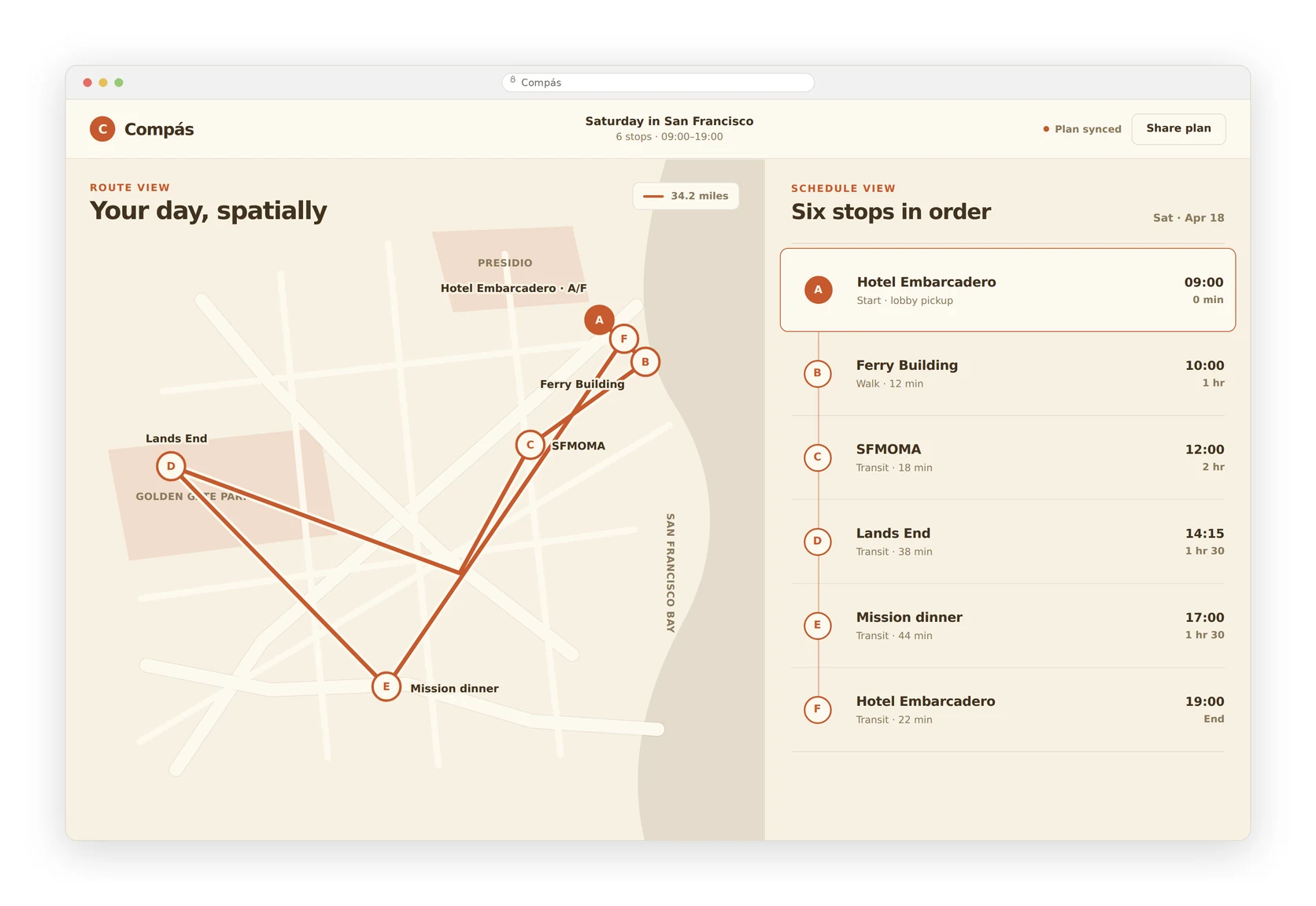
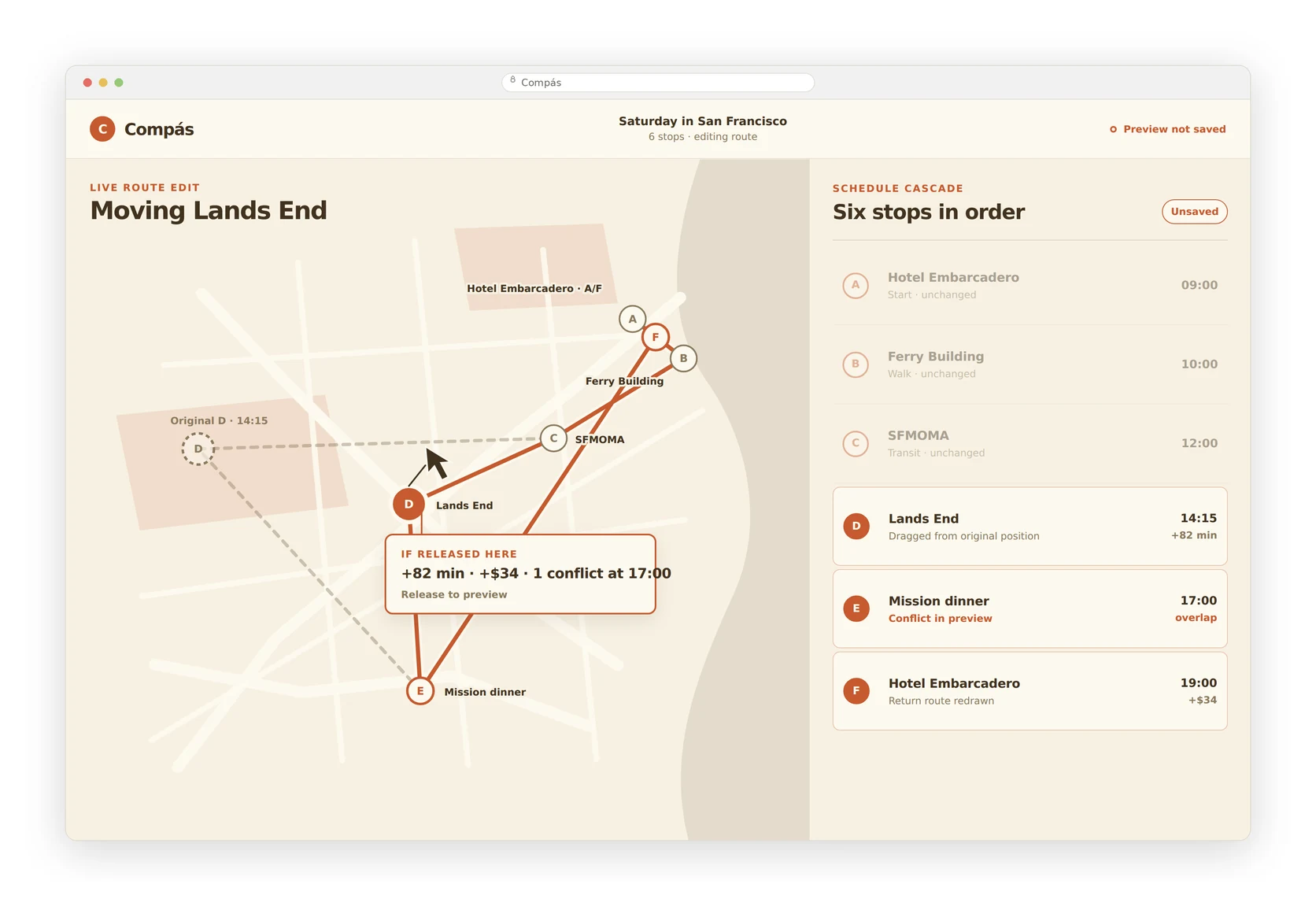
You tell Compas what you want out of the trip — natural language, constraints included. It drafts your choices onto a linked pair: a map with physical points, and a per-day schedule. Then the design bet: both sides are handles on the same plan. Drag a point on the map and the day reflows; move an item in the scheduler and the route redraws. Jumping around a city stops being an abstraction — the zigzag shows itself, with its time and money attached, while you’re still playing.
04What five conversations said
The first five planners I talked with — people like me, already using AI for discovery and logistics help — converged on one refrain: until we see everything on a map, nothing really makes sense (paraphrased; n=5, a sample of people like me — broadening it is the next gate). AI has made finding things easy. It hasn’t made arranging them make sense. That gap is the product.
05Where the AI sits — and where the human must
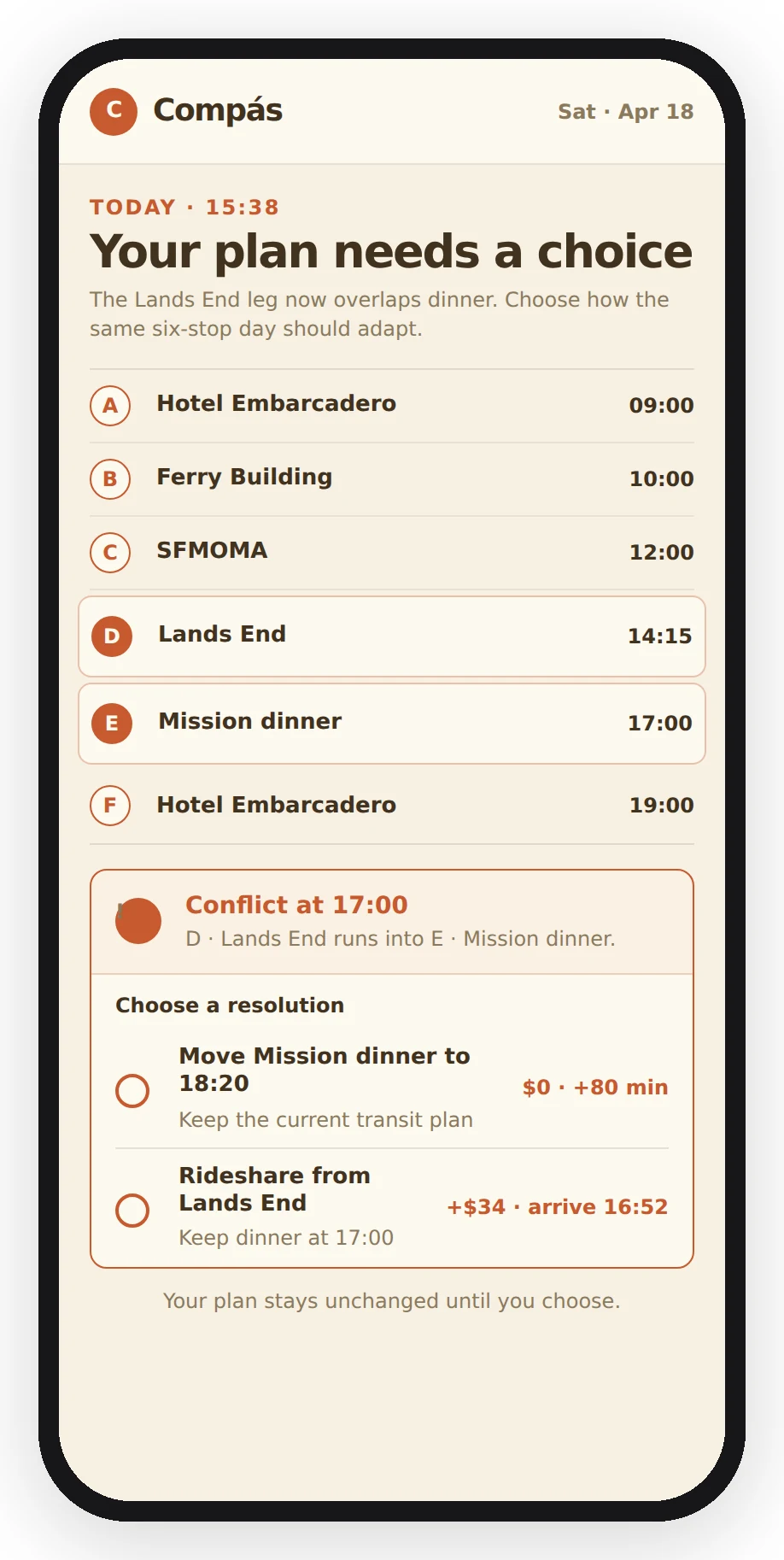
The model does all of it: interprets the natural-language intent, synthesizes the research, drafts the plan, simulates the consequence chains — time constraints, route efficiency, compounding costs, conflicts and dependencies. The human job is exactly one thing, and it’s the same discipline as my enterprise AI work: see the consequences of your constraints against the routing, and confirm what you can see. Space is the primary consequence surface — the others become visible the moment your schedule starts jumping around the map.
06What I don’t know yet
Whether this ships commercially — genuinely undecided; it may live as a design-research vehicle first. Which of the four planners to serve first. And whether the dual-surface interaction survives contact with real complexity. The success gate is unambiguous though: Compas earns more of my time when I plan my own trips faster with it than without it. Sketches are the next artifact — Gate 2 of the process this site runs on.
The working notes
Method, evidence, constraints, and the lesson so far — updated as the work moves.
EvidenceFive conversations, one refrain
All five early conversations were with planners already using AI for discovery and logistics. Every one hit the same wall: the pieces are easy to find now, impossible to arrange with confidence. The refrain — “until we see everything on a map, nothing really makes sense” — is paraphrased and footnoted: n=5, people similar to me. The next evidence gate is planners who are NOT me: a tour operator and an event planner, on the record.
MethodThe consequence hierarchy
Space first: inefficient routing is the consequence people feel physically, and it’s where the others surface — jump around the map and the time cost, compounding money, and conflicts all become legible in one gesture. Design order follows: render route consequence in the drag interaction itself; attach time and cost as its badges; surface conflicts and dependencies the moment a move creates one. One primary surface, three consequences riding on it.
MethodThe three-way split: model, field, sketch
Models interpret intent, synthesize research, draft plans, and simulate ripples. Field conversations name the fears worth modeling and keep the sample representative. Sketches invent the dual-surface interaction, since no consequence-first planning pattern exists to borrow. Each leg checks the other two.
ConstraintWork in progress, sample bias included
This case study updates live under the site’s evidence rules — and the first bias is already documented: five people like me is a hunch validator, not a market. Commercial intent is undecided and says so. An in-progress study that pretends to certainty would break the rules this site runs on.
LessonAI moved the bottleneck
The early insight worth keeping: AI collapsed discovery — everyone can find the restaurants, the trails, the venues. The bottleneck moved downstream to arrangement, where consequences live. Products that only make finding easier are solving the previous decade’s problem.
An API marketplace for customers who might not be human →
See Compas pitch itself ↗ Simulated product site — built as part of this case study.